The Professional Activities Fund (PAF) exists to enhance professional development activities in the engineering undergraduate program at UBC Vancouver. It is designed to support co-curricular activities and projects that lie outside of, yet are complementary to, the engineering curriculum. All PAF funded activities must be in support of this mandate.
PAF collects fees from all undergraduate UBC Engineering students each fall. Only currently enrolled undergraduate UBC Engineering students may benefit from the fund.
Please look through the Professional Activities Fund Mandate carefully before applying.
General PAF Criteria
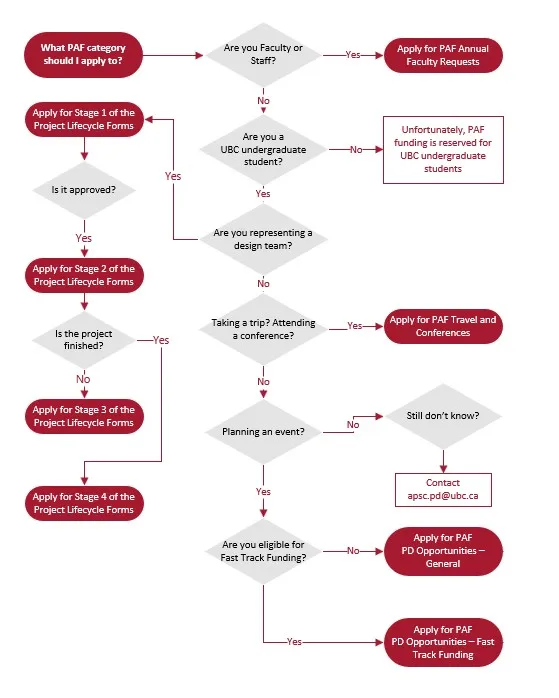
PAF Funding is awarded in the four categories: Faculty Requests, Travel & Conferences, Professional Development (PD) Opportunities, and Engineering Design Teams (all activities). There are subcategories of PD Opportunities: General Funding, Fast Track Funding for E-IDEAS, and Fast Track Funding for EUS Clubs and Departments . Each category has specific criteria.
All applications must meet the following eligibility criteria:
- Be student-run and organized and have a clear goal.
- The application must support the experiential learning and professional development of undergraduate UBC Engineering students, and be separate from the engineering curriculum, but related to the profession of engineering.
- Applicants must be currently enrolled undergraduate UBC Engineering students within the PAF academic year of application.
- At least 75% of the beneficiaries of the application must be currently enrolled undergraduate UBC Engineering students. When it is possible to distinguish direct costs per beneficiary (such as in the case of travel), PAF will only provide funding for currently enrolled undergraduate UBC Engineering students.
- A single initiative may only be funded through one PAF category.
- PAF only provides funding for initiatives within its current academic year (Sept 1st – Aug 31st).
- PAF does not fund organizations. PAF will provide funding for specific projects or travel, which may be applied to on behalf of an organization.
- Applications must show a balanced and responsible budget. While PAF won’t fund applications that are for profit or run a deficit, limited and well-justified carryover may be permitted.
- All spending should align with APSC’s Financial Guidelines – please review before submitting applications or reimbursements.
- PAF funds should be spent in the most reasonable way; PAF may modify, or request resubmissions based on this. Costs that are not on the pre-approved lists and/or the most reasonable option may not be reimbursed at the full amount.
- Applications must follow the format requested by APSC PD (for example, locked spreadsheets).
- Only actual monetary expenditures paid by the applicant will be counted toward the total project/application spend. Gifts in kind (e.g., discounts, donated goods, donated services, etc.) will not be included when calculating total spend for PAF purposes.
- Engineering Design teams should refer to their section of the Mandate document for total caps. EDTs are ineligible to apply to PAF non-EDT funding categories as an alternate funding source for Design Team activities. All EDT adjacent/related activities including competitions, conferences and PD events fall under the EDT category.
- Non-EDT Categories - Limit of 5 PAF approved applications per group and/or individual, to a maximum approved funding cap of $10,000 (total, across all PAF funding envelopes).
- Applications seeking funding for academic research will only be approved as an official Engineering Design Team project.
- Funding for entrepreneurship activities, including supplies, materials, equipment, and operational costs, are not eligible for PAF funding.
- PAF does not fund academic bursaries, awards, or grants.
PAF Categories
PAF is broken into four primary categories: Annual Faculty Requests, Travel & Conferences and Engineering Design Teams , and PD Opportunities. These are described in detail on their respective pages and in the PAF Mandate. The flow chart below is intended to help applicants identify which category best fits their request.